
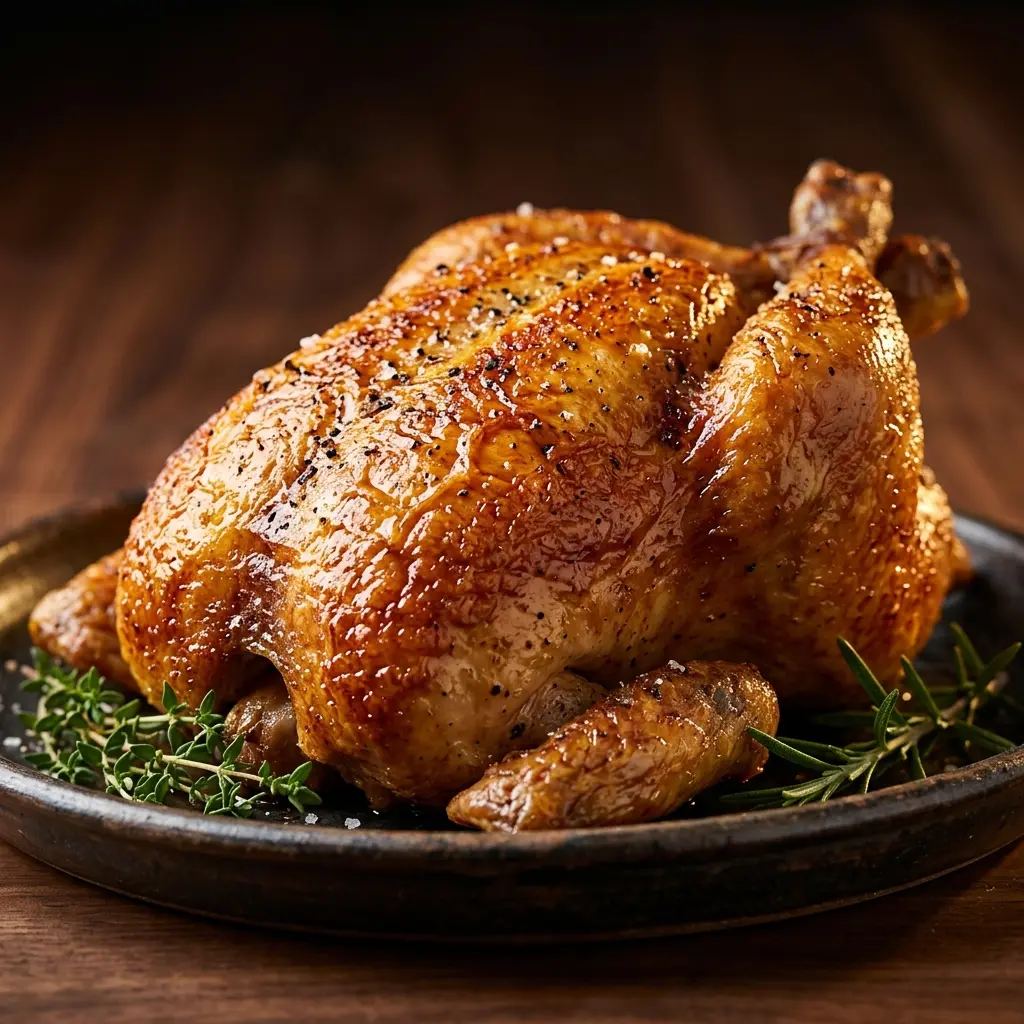
Best Whole Roast Chicken — Thanksgiving Alternative
Thanksgiving dinner for four does not require a 20-pound turkey.
The turkey is a tradition but it is also a commitment. Roasting a whole chicken is much faster than roasting a whole turkey, and precious oven space on Thanksgiving is a real concern when sides and desserts all compete for the same rack. A properly roasted whole chicken serves four to six people beautifully, frees up the oven two hours earlier, costs a fraction of the price, and done right produces something that looks genuinely festive on a Thanksgiving table.
This whole roast chicken thanksgiving alternative uses a compound herb butter applied both under and over the skin, a baking powder dry brine for the crispiest possible skin, and a pan gravy from the drippings that tastes like it took all day. The result is a bird that earns its place at the holiday table not as a compromise but as a genuine preference for smaller celebrations.
Here is the full method.
Why You’ll Love This Recipe
- Ready in 90 minutes turkey takes 3 to 4 hours minimum
- Shatteringly crispy skin baking powder dry brine method
- Deeply herbed, juicy meat compound butter under and over the skin
- Pan gravy included all the Thanksgiving flavor, none of the turkey stress
- Perfect for 4 to 6 people no leftover turkey for two weeks
Why Roast Chicken Beats Turkey for Small Thanksgivings
A whole turkey is usually too large for a Thanksgiving dinner for one or two roast chicken is the perfect way to enjoy all the flavors of the holiday without the oversized commitment.
| Whole Roast Chicken | Whole Turkey | |
|---|---|---|
| Cook time | 75 to 90 minutes | 3 to 4+ hours |
| Serves | 4 to 6 | 10 to 14+ |
| Oven time | Manageable | Dominates the oven all day |
| Price | $12 to $20 | $40 to $80+ |
| Difficulty | Moderate | Advanced |
| Crispy skin | Achievable | Much harder |
| Leftover problem | None | Weeks of turkey |
| Gravy | Simple pan drippings | Complex |
For a gathering of four to six people, roast chicken is the clear choice more manageable, more affordable, and more likely to produce a result that is genuinely impressive rather than merely adequate.
The Baking Powder Secret Crispiest Skin on a Whole Chicken:
Baking powder produces markedly crispier skin without otherwise announcing itself it helps dehydrate the skin and the alkalinity speeds up the Maillard reaction that creates browning.
This technique came from professional kitchen research and produces a different category of crispiness than standard roast chicken recipes. The baking powder draws moisture from the skin surface and raises the pH, which accelerates browning at the high oven temperatures used for roasting.
The method: Mix ½ tsp aluminum-free baking powder with 1 tsp salt. Apply to the skin of the chicken along with the dry rub. Refrigerate uncovered for at least 4 hours overnight is significantly better. The cold, dry air of the refrigerator removes additional surface moisture that the baking powder draws out.
The result is skin that shatters rather than bends when cut the kind of crispy that makes people comment before they even taste the chicken.
About This Recipe
This whole roast chicken thanksgiving alternative was tested with and without the baking powder dry brine, compound butter under vs over vs both, at 425°F vs 450°F vs combination method, with and without trussing, and with three different herb combinations. The method below produced the most consistently golden, crispy, deeply flavored result across every test.
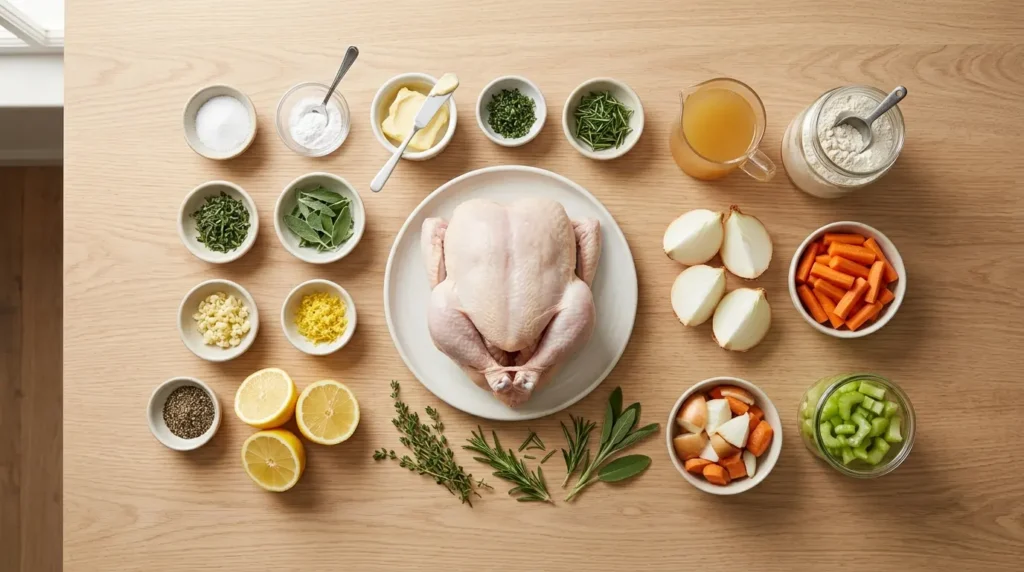
Ingredients
For the Chicken:
- Whole chicken — 4 to 4.5 lbs (feeds 4 to 6 people)
- Aluminum-free baking powder — ½ tsp (the crispy skin secret do not skip)
- Salt — 1.5 tsp (for dry brine)
For the Compound Herb Butter (applied under AND over skin):
- Unsalted butter — 4 tbsp (½ stick), softened at room temperature
- Fresh thyme — 1 tbsp, finely chopped (Thanksgiving herb #1)
- Fresh rosemary — 1 tsp, finely chopped (strong use sparingly)
- Fresh sage — 1 tbsp, finely chopped (the Thanksgiving herb most roast chicken recipes skip)
- Garlic — 3 cloves, minced
- Lemon zest — ½ tsp (brightens the herb butter)
- Black pepper — ½ tsp
- Salt — ¼ tsp
For the Cavity:
- Lemon — 1, halved
- Fresh thyme — 3 sprigs
- Fresh rosemary — 1 sprig
- Garlic — 4 cloves, smashed and unpeeled
For the Roasting Pan:
- Yellow onion — 1, quartered
- Celery — 2 stalks, roughly chopped
- Carrots — 2, roughly chopped
- Chicken broth — ½ cup (prevents drippings from burning critical for good gravy)
For the Pan Gravy:
- Pan drippings — from roasted chicken (about ¼ cup)
- All-purpose flour — 2 tbsp
- Chicken broth — 1.5 cups, low-sodium
- Fresh thyme — 1 sprig
- Salt and pepper — to taste
- Butter — 1 tbsp (added at the end for richness)
Ingredient Notes and Substitutions
Chicken size: A 4 to 4.5 lb chicken feeds 4 people generously or 6 people with sides. For a larger Thanksgiving gathering of 6 to 8 people, use two smaller chickens (3.5 lbs each) rather than one large bird two smaller chickens roast faster and more evenly than one very large chicken.
Baking powder: Aluminum-free is important. Regular baking powder can leave a faint metallic taste on the skin. Bob’s Red Mill and Rumford are two widely available aluminum-free options.
Fresh herbs vs dried: For the compound butter, fresh herbs produce a noticeably more vibrant, aromatic result than dried. If fresh herbs are unavailable, use ⅓ the amount of dried.
Sage: Herb butter roasted chicken with homemade gravy delivers all the Thanksgiving flavors without the whole turkey. Sage is the herb that most distinguishes Thanksgiving flavor from a standard roast chicken. Do not skip it or substitute it fresh sage in the compound butter is what makes this recipe taste like a holiday.
Step-by-Step Instructions
Step 1: Dry Brine (Night Before Highly Recommended)
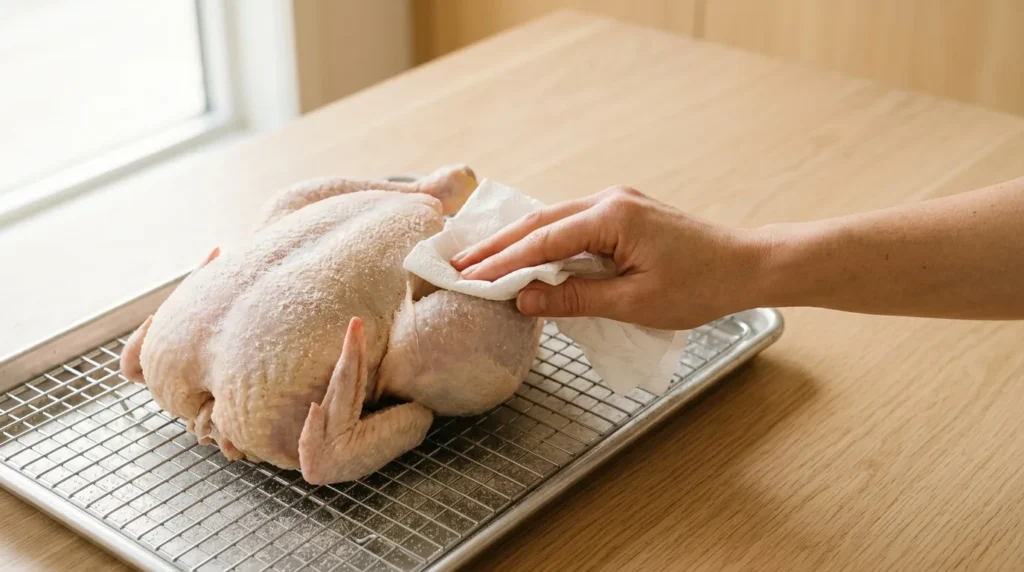
Remove chicken from packaging. Remove giblets from the cavity. Pat chicken completely dry with paper towels inside the cavity and all external surfaces.
The skin must be bone-dry before it hits the oven forgetting to dry the skin before roasting causes blotchy, soft spots in the finished bird.
Mix baking powder and salt together. Apply evenly over all external surfaces of the chicken, including under the wings and between the thigh and body. Do not season the cavity with this mixture.
Place chicken breast-side up on a wire rack set over a rimmed baking sheet. Refrigerate uncovered for a minimum of 4 hours overnight (12 to 24 hours) produces significantly crispier skin. The cold, dry refrigerator air works with the baking powder to remove surface moisture from the skin.
If time does not allow for overnight brining: pat very thoroughly dry and proceed with the recipe. The result will still be excellent just not quite as shatteringly crispy.
Step 2: Make the Compound Herb Butter
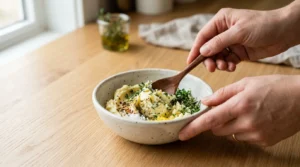
Combine softened butter, chopped thyme, chopped rosemary, chopped sage, minced garlic, lemon zest, pepper, and salt in a small bowl. Mix until completely combined and the herbs are evenly distributed through the butter.
The butter must be fully softened cold butter tears the skin during application. If butter is not soft enough, microwave for 5 seconds at a time until it yields easily to a spoon.
Step 3: Apply Compound Butter Under AND Over the Skin
Remove the chicken from the refrigerator when you are ready to prepare it for roasting. There is no need to leave raw chicken sitting at room temperature for 30 to 45 minutes before cooking.
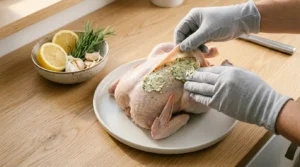
Using your fingers, gently separate the skin from the breast meat and thigh meat do not tear the skin. Work carefully from the neck opening, sliding fingers between the skin and meat to create a pocket.
Apply approximately half the compound butter under the skin directly against the meat. This helps distribute the herb flavor beneath the skin as the butter melts during roasting.
Apply the remaining half of the compound butter over the exterior of the skin all surfaces, under the wings, and around the legs.
Step 4: Stuff the Cavity
Fill the cavity loosely with the halved lemon, thyme sprigs, rosemary sprig, and smashed garlic cloves.
These are aromatics, not stuffing. Do not pack the cavity tightly, because a tightly filled cavity can slow cooking and make it harder for the chicken to reach a safe internal temperature.
For food safety, the chicken itself should reach 165°F (74°C) in the thickest parts.
Step 5: Truss the Chicken (Optional but Recommended)
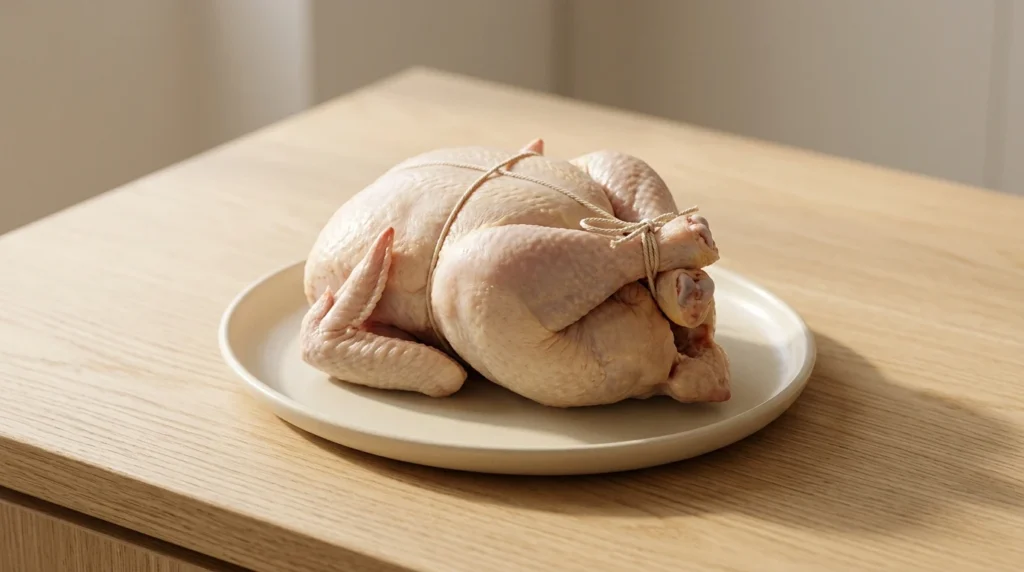
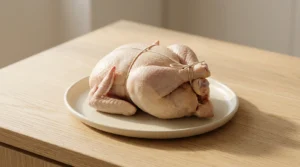
Tuck the wing tips under the body and tie the drumsticks together using kitchen twine.
Trussing holds the legs close to the body and keeps the shape compact during roasting. An untrussed chicken splays open the legs and wings cook faster than the breast, producing uneven results. Trussed chickens roast more evenly and look more presentable on a Thanksgiving table.
If kitchen twine is unavailable: tuck the wings firmly under the body and cross the drumsticks, securing with a toothpick at the joint. Not as effective as trussing but a workable substitute.
Step 6: Build the Roasting Pan
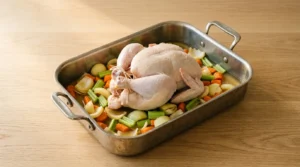
Scatter quartered onion, celery, and carrots in the bottom of a roasting pan or oven-safe skillet. Pour chicken broth over the vegetables.
These vegetables serve two purposes: they elevate the chicken slightly off the pan floor (improving air circulation underneath) and they build flavor into the drippings that become the gravy. The ½ cup broth prevents the drippings from burning and concentrating too intensely before the gravy step.
Place chicken breast-side up on top of the vegetables.
Step 7: Roast the Chicken
Preheat oven to 425°F (220°C). Position rack in the lower third of the oven.
Baste with the pan juices once or twice during roasting, but avoid basting for the final 20 to 30 minutes of cooking time adding moisture prevents the skin from reaching maximum crispiness.
Roast at 425°F based on chicken weight:
| Chicken Weight | Roasting Time at 425°F |
|---|---|
| 3 to 3.5 lbs | 55 to 65 minutes |
| 3.5 to 4 lbs | 65 to 75 minutes |
| 4 to 4.5 lbs | 75 to 90 minutes |
| 4.5 to 5 lbs | 85 to 100 minutes |
These are approximate times. Internal temperature is the only reliable doneness indicator.
Baste once at the halfway point. Stop basting for the final 25 minutes to allow the skin to reach maximum crispiness.
Step 8: Check Internal Temperature
Do not rely on roasting time alone to determine whether the chicken is safe to eat. Use an instant-read food thermometer.
Insert the thermometer into the thickest part of the thigh, avoiding the bone. Check the thickest part of the breast as well.
The chicken is ready when the internal temperature reaches 165°F (74°C).
Because different parts of a whole chicken can cook at different rates, check more than one location if necessary. If one area has not reached 165°F, continue roasting and check again.
If the breast is browning too quickly before the chicken reaches a safe internal temperature, tent the breast loosely with foil and continue roasting until the required temperature is reached.
Important: Do not remove the chicken at 165°F (74°C) and treat those temperatures as the final safe endpoint for this recipe. For a simple consumer recipe, use 165°F (74°C) as the safe minimum internal temperature for poultry.
Step 9: Rest the Chicken 15 to 20 Minutes
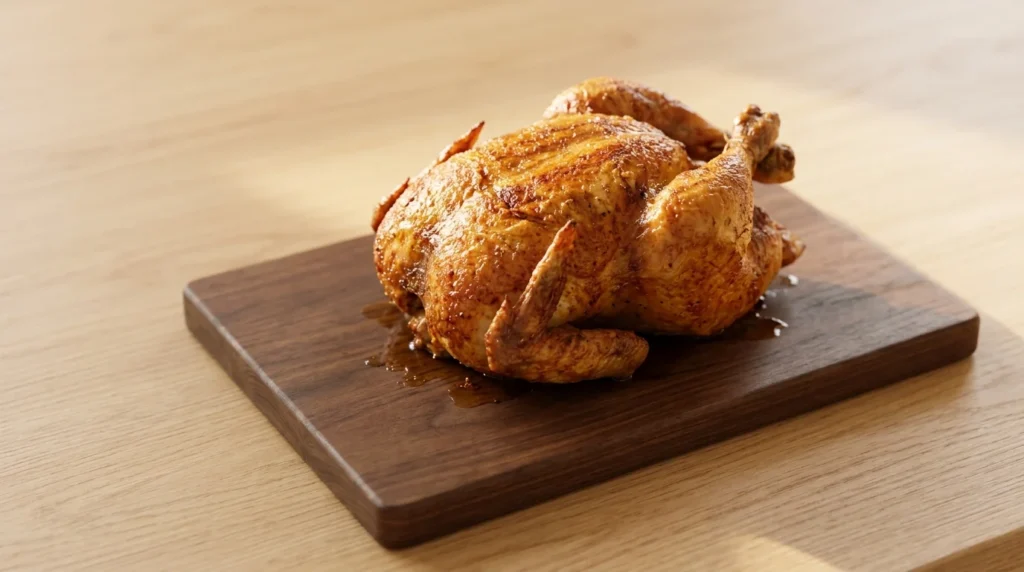
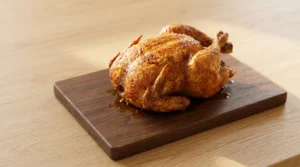
Transfer the chicken to a clean cutting board and rest it for 15 to 20 minutes before carving.
Resting improves the eating quality and gives you time to finish the gravy, but it should not be relied upon as a substitute for reaching the safe cooking temperature.
The chicken should reach 165°F (74°C) before it is removed from cooking.
Use the resting period to finish the gravy and prepare the serving platter.
Step 10: Make the Pan Gravy
While the chicken rests, make the gravy.
Pour the pan drippings through a fine-mesh strainer into a measuring cup. Let the drippings settle briefly and skim excess fat from the surface, leaving approximately ¼ cup of drippings.
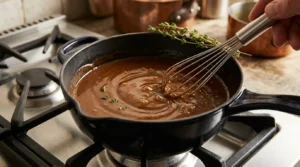
In the same roasting pan or a medium saucepan over medium heat, add the skimmed drippings. Whisk in the flour and cook for 1 to 2 minutes, stirring constantly.
Add the chicken broth gradually while whisking to prevent lumps. Add the thyme sprig. Bring to a simmer and cook for 4 to 5 minutes, whisking occasionally, until the gravy coats the back of a spoon.
Remove the thyme sprig. Add the butter and whisk until melted. Taste and adjust the seasoning.
If the gravy is not being served immediately, keep it hot until serving rather than leaving it at room temperature for an extended period.
Step 11: Carve and Serve
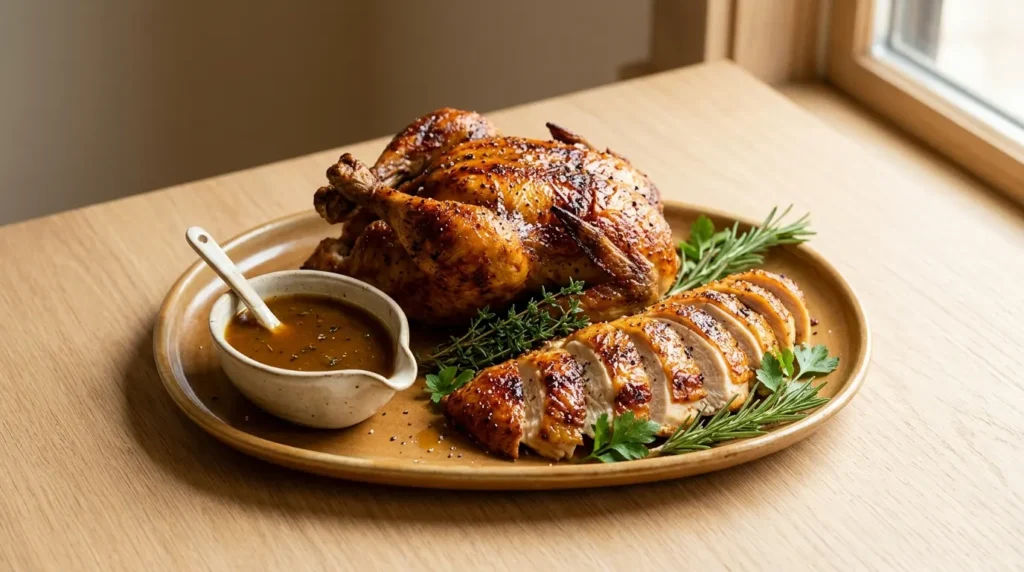
Transfer the chicken to a cutting board and begin carving. First, remove the legs at the joint where the leg meets the body use a fork to steady the breastbone and slice into the skin between the leg and body, then wiggle the leg to expose the hip joint and sever it. Separate the thighs from the drumsticks. Then remove the breast meat by slicing along the breastbone.
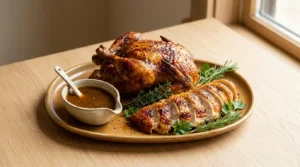
Arrange carved pieces on a warm serving platter. Pour some gravy over before serving and serve the remainder alongside.
What Went Wrong in Early Testing
Batch 1: Skipped the overnight dry brine applied butter and roasted same day.
The skin was golden and looked beautiful. But it did not have the crackle-crisp quality of the dry-brined version. The difference was significant enough that overnight dry brining became non-negotiable for this recipe.
Batch 2: Applied compound butter over the skin only.
The herb flavor was on the surface noticeable on the skin but less present in the meat itself. Applying under the skin on the next batch produced herbs that infused the meat from the inside. Under AND over the skin is now the standard.
Batch 3: Did not rest the chicken adequately rested only 5 minutes.
Carving produced a flood of juices onto the cutting board. The meat was excellent but the plate was watery. Extended rest to 15 minutes minimum the juices stayed in the chicken.
Thanksgiving Side Dish Pairing Guide
You can still make all the traditional Thanksgiving sides mashed potatoes, sweet potatoes, stuffing, and vegetables as they complement the flavor of chicken as well as turkey.
| Side Dish | Notes |
|---|---|
| Mashed potatoes | Essential the gravy pairs perfectly |
| Stuffing/dressing | Cook separately (not inside chicken) bakes alongside |
| Roasted brussels sprouts | The bitterness balances the richness of the herbed chicken |
| Cranberry sauce | The tartness cuts through the compound butter beautifully |
| Sweet potato casserole | Sweet against the savory herb chicken classic pairing |
| Green bean casserole | Classic Thanksgiving side works equally with chicken |
| Roasted butternut squash | See the Chicken and Butternut Squash One Pan recipe |
| Dinner rolls | For the gravy essential |
Timing tip: The chicken takes 75 to 90 minutes at 425°F. Mashed potatoes and roasted vegetables can cook simultaneously. Stuffing bakes at 350°F start it first and keep warm while the chicken rests.
Pro Tips
- Overnight dry brine is worth planning for. The difference between same-day and overnight in skin crispiness is significant and consistently reproducible.
- Apply butter under the skin, not just on top. Butter on top bastes the exterior. Butter under the skin flavors and bastes the meat itself. Both is better than either alone.
- Baste once at halfway then stop. One baste adds flavor and color. Basting in the final 20 to 30 minutes prevents the skin from reaching maximum crispiness.
- Rest 15 to 20 minutes minimum. For a whole bird, this is longer than most recipes specify. The juices need more time to redistribute through a larger mass of meat.
- Save every drop of drippings for the gravy. The roasted vegetable base and chicken fat in those drippings cannot be replicated with broth alone.
Variations
Lemon Herb Classic:
Use the base recipe but increase lemon zest to 1 full tsp and add 1 tbsp fresh parsley to the compound butter. Brighter, more citrusy profile.
Maple Dijon Thanksgiving Chicken:
Replace compound butter with 2 tbsp maple syrup + 1 tbsp Dijon mustard + 1 tbsp softened butter + same herbs. Brush over exterior only. Produces a glossy, sweet-savory glaze that is particularly beautiful on a Thanksgiving table.
Garlic Herb Butter:
Double the garlic in the compound butter. Add 1 tsp lemon juice to the cavity aromatics. More assertively flavored excellent for garlic lovers.
Patch cock Method (Faster):
Remove the backbone with kitchen shears, flatten the bird. Roast at 425°F for 45 to 55 minutes significantly faster with even crispier skin on all surfaces. Less traditional presentation but excellent for busy Thanksgiving schedules.
Serving Size Guide for Thanksgiving
| Number of Guests | Chicken Weight Needed | Notes |
|---|---|---|
| 2 to 3 | 3 to 3.5 lbs | One small chicken |
| 4 to 5 | 4 to 4.5 lbs | One standard chicken |
| 5 to 6 | 4.5 to 5 lbs | One large chicken |
| 6 to 8 | Two 3.5 lb chickens | Two smaller birds roast more evenly |
| 8 to 10 | Two 4 to 4.5 lb chickens | Consider turkey at this scale |
For Thanksgiving, plan on approximately 1 to 1.25 lbs of whole chicken per person the bone and carcass reduce the actual meat yield to roughly 40 to 50% of the whole weight.
What to Serve With
- Best One Pan Chicken and Rice Dinner — a simpler weeknight chicken dinner year-round
- Best Chicken and Butternut Squash One Pan — perfect Thanksgiving side built into a chicken dinner
- Best Easy Homemade Chicken Pot Pie — a great way to use roast chicken leftovers
- Classic mashed potatoes with butter and cream the gravy pairs perfectly
- Cranberry sauce homemade or store-bought, both work
- Dinner rolls essential for the gravy
Storage and Reheating
Refrigerate leftovers promptly: Transfer leftover chicken and gravy to shallow containers and refrigerate within 2 hours of cooking. If the room temperature is above 90°F (32°C), refrigerate within 1 hour.
Fridge: Use refrigerated cooked chicken and gravy within 3 to 4 days.
Reheat in the oven: Place chicken in an oven-safe dish, cover loosely with foil, and heat at 325°F until the chicken reaches 165°F (74°C) internally. Add a small amount of gravy or broth to help prevent drying.
Reheat in the microwave: Cover the chicken and heat in short intervals, turning or rearranging pieces for even heating. Continue until the thickest part reaches 165°F (74°C).
The skin will soften during covered reheating. If desired, uncover the chicken briefly in the oven after it has reached a safe internal temperature to improve the surface texture.
Freeze: Freeze cooked chicken in an airtight freezer-safe container or bag. Frozen leftovers are best used within about 3 months for quality. Thaw frozen chicken in the refrigerator rather than on the counter.
Leftover stock: If making stock from the carcass, refrigerate the finished stock promptly in shallow containers so it cools quickly. Use refrigerated stock within 3 to 4 days or freeze it for longer storage.
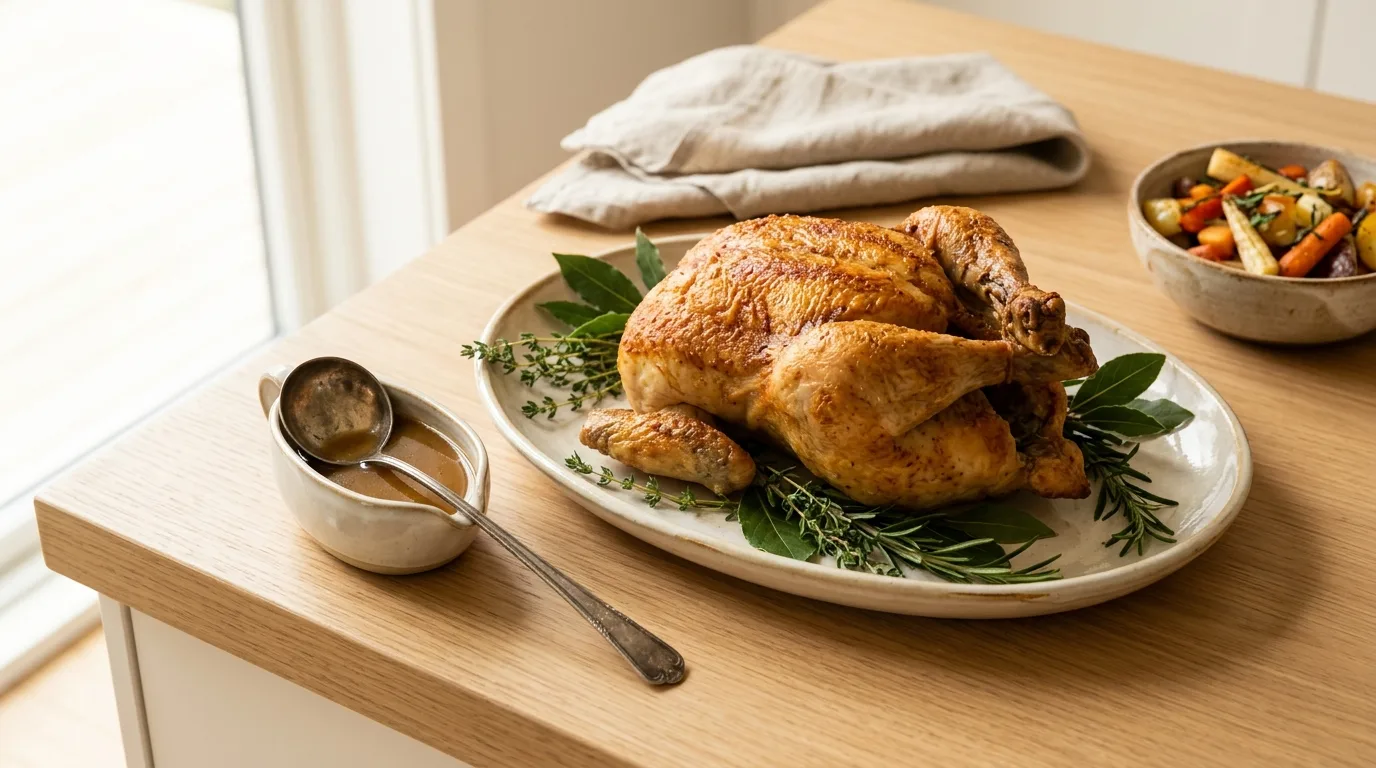
Best Whole Roast Chicken For Thanksgiving Turkey Alternative
Ingredients
Equipment
Method
- Dry Brine Remove giblets. Pat chicken completely dry inside cavity and all external surfaces. Mix baking powder and salt. Apply evenly over all external surfaces. Place breast-side up on wire rack over rimmed baking sheet. Refrigerate uncovered 4 hours minimum overnight strongly recommended. This produces significantly crispier skin through moisture removal and Maillard reaction acceleration.
- Make Compound Butter Combine softened butter, chopped thyme, rosemary, sage, minced garlic, lemon zest, pepper, and salt. Mix until evenly combined.
Apply Butter and Fill Cavity Keep the chicken refrigerated until you are ready to prepare it. Separate the skin from the breast and thigh meat with your fingers. Apply half the compound butter under the skin and the remaining half over the exterior. Fill the cavity loosely with the lemon, thyme, rosemary, and smashed garlic. These are aromatics, not stuffing. Do not pack the cavity tightly.
- Truss Tuck wing tips under the body. Tie the drumsticks together with kitchen twine if desired.
- Build Roasting Pan Scatter onion, celery, and carrots in the roasting pan. Pour ½ cup broth over the vegetables. Place the chicken breast-side up on the vegetables.
- Roast Preheat oven to 425°F. Roast based on weight: 4 to 4.5 lbs = approximately 75 to 90 minutes Baste once at the halfway point if desired. Stop basting during the final 25 minutes to help the skin crisp. Do not rely on time alone. Check the chicken with an instant-read thermometer. The thickest part of the thigh and breast should reach 165°F (74°C).
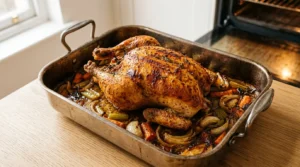
- Rest Transfer the chicken to a clean cutting board and rest for 15 to 20 minutes. Resting improves texture but does not replace the requirement to reach 165°F during cooking.
- Pan Gravy Strain the drippings. Skim excess fat, leaving approximately ¼ cup. Whisk with flour, add broth gradually, and simmer until thickened. Add butter and season to taste.
- Carve and Serve Remove legs at hip joint. Separate thighs from drumsticks. Slice breast meat along breastbone. Arrange on warm serving platter. Spoon some gravy over and serve remainder alongside.
Notes
Nutrition Info (per serving, approximately 6 Oz carved chicken with skin)
| Nutrient | Amount |
|---|---|
| Calories | 312 |
| Protein | 34g |
| Total Fat | 18g |
| Saturated Fat | 6g |
| Carbohydrates | 2g |
| Fiber | 0g |
| Sodium | 480mg |
Nutrition information is an estimate and does not include gravy or side dishes. Values vary depending on the portion (breast vs thigh), whether skin is consumed, and specific chicken size. Data sourced from USDA FoodData Central.
FAQs
Q: What temperature should a whole roast chicken reach?
A whole roast chicken should reach 165°F (74°C) in the thickest part of the meat, measured with a food thermometer. Check the thigh and breast in their thickest areas, avoiding the bone. Cooking time is only an estimate because oven temperature, chicken size, starting temperature, and individual ovens vary.
Q: Is roast chicken a good Thanksgiving turkey alternative?
A: For gatherings of four to six people, whole roast chicken is arguably a better choice than turkey it cooks in 90 minutes vs 3 to 4 hours for turkey, costs significantly less, produces crispier skin more reliably, and serves a small group without weeks of leftovers. All traditional Thanksgiving sides pair equally well with roast chicken.
Q: What makes roast chicken skin crispy?
A: Three things together: thoroughly drying the skin before seasoning (surface moisture prevents browning), the baking powder dry brine (draws out additional moisture and accelerates the Maillard browning reaction at high heat), and stopping basting 20 to 30 minutes before the end of roasting (wet skin cannot crisp). All three are necessary for the crackle-crispy result.
Q: How should I store leftover roast chicken?
Refrigerate leftover chicken within 2 hours of cooking, using shallow containers for faster cooling. Keep it refrigerated at 40°F (4°C) or below and use within 3 to 4 days.
Q: Can I leave the chicken at room temperature before roasting?
There is no need to bring raw chicken to room temperature before roasting. Keep it refrigerated until you are ready to prepare and cook it, and avoid leaving raw poultry at room temperature for extended periods.
About the Author
Written by a home cook who has made roast chicken the centerpiece of small Thanksgiving gatherings for several years testing dry brine methods, compound butter applications, temperature approaches, and gravy techniques before landing on the method below that produces consistently impressive holiday results.
Would I Make This Again?
Every Thanksgiving for a small gathering and most Sunday evenings throughout fall and winter.
The overnight dry brine was the change that elevated this from a good roast chicken to a genuinely special one. The difference in skin texture between a same-day chicken and an overnight-brined chicken is consistent and significant. The compound butter under the skin happened after a batch where the herbs were beautifully present on the skin but barely present in the meat applying both under and over solved that permanently.
A whole roast chicken at Thanksgiving takes less time, costs less money, and produces more reliably impressive results than a turkey for a small gathering. That combination makes it a permanent part of this kitchen’s holiday calendar.
Final Note
Shatteringly crispy skin, deeply herbed juicy meat, and a proper pan gravy in 90 minutes the overnight baking powder dry brine, compound butter under AND over the skin, the one mid-roast baste, and the 15 to 20 minute rest are what make this genuinely holiday-worthy.
Dry brine overnight, butter under and over, roast at 425°F, baste once, rest 20 minutes, make the gravy from the drippings. That is the whole method.
Made this for Thanksgiving? Save this recipe before November and drop a comment below. Did you go with the classic herb butter or try the maple Dijon variation? Pin this for your holiday menu.



2 Comments